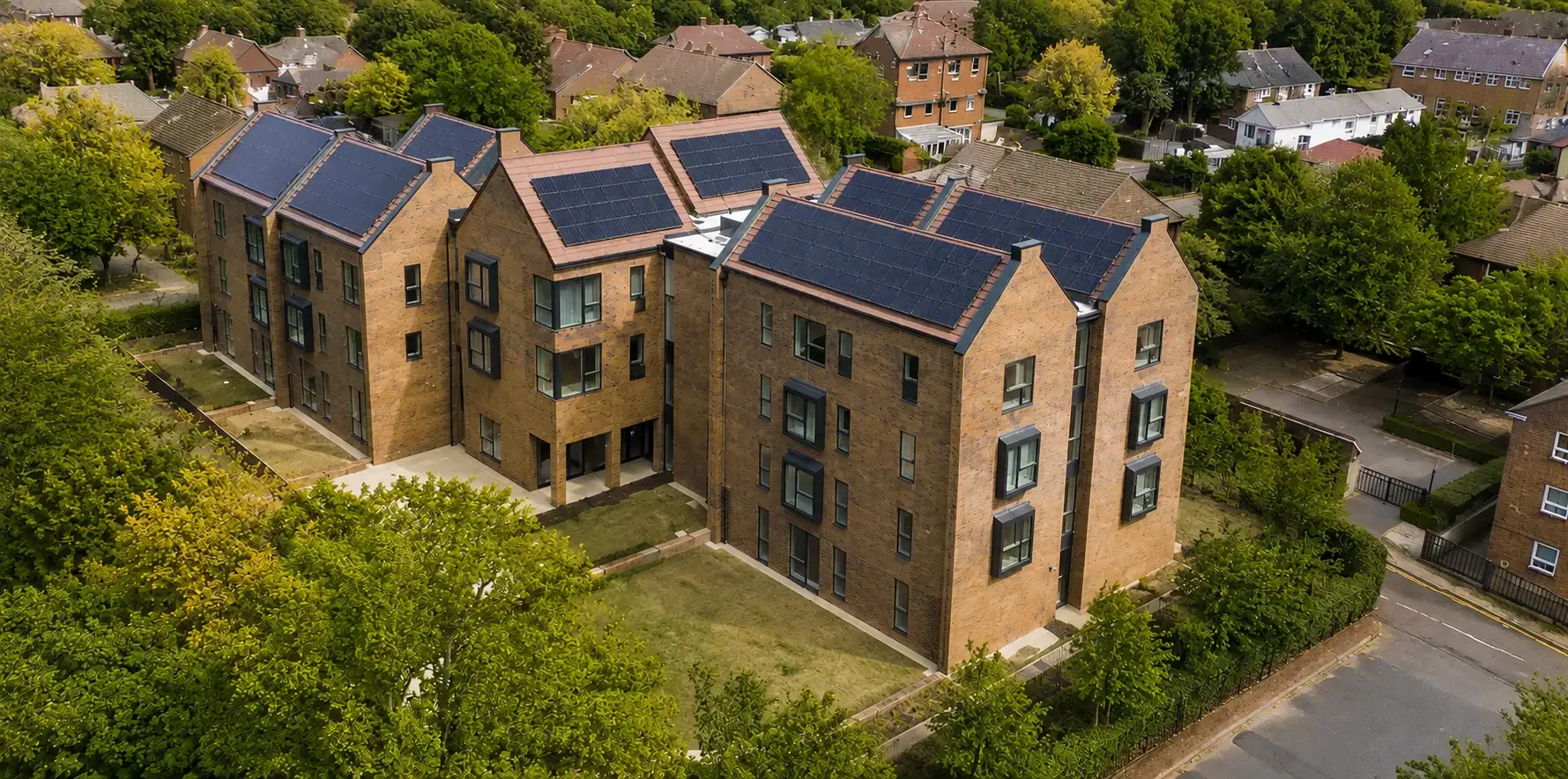
Patey Court

7.7 kgCO₂/m² Building Emission Rate
40% Lower CO₂ vs Target Emissions
62% Reduction Heating Energy Demand
7.03 kWh/m² Solar PV Generation

Solar PV Installation.

Patey Court is a supported living residential development in Portsmouth, designed to provide energy-efficient accommodation while meeting modern building performance standards. The project integrates low-carbon technologies and high-performance building fabric to minimise energy consumption and operational emissions.

The Challenge:

The project required compliance with Part L Building Regulations while delivering a high-performance residential building with reduced energy demand and carbon emissions.
The building needed to achieve emissions below the Target Emission Rate (TER) of 12.9 kgCO₂/m².
Heating demand needed to be minimised while maintaining occupant comfort.
Building fabric performance had to significantly exceed standard compliance levels.
Operational performance identified low domestic hot water return temperatures (~25–40°C), indicating inefficiencies in system distribution.

The Solution:

Salvis provided energy modelling, compliance analysis, and technical investigation to support both design performance and operational improvements.
Full SBEM / IES energy modelling to demonstrate compliance and optimise performance.
Integration of roof-mounted solar PV system generating onsite renewable energy.
High-performance building fabric achieving significantly reduced U-values.
Efficient heating system design with low heating demand (2.59 kWh/m²).
Hot water system investigation identifying return temperature inefficiencies.
Recommendation to reconfigure HWS return pipework to improve thermal performance and system balance.
Solar PV System On-Site Renewable Energy
Thermal Modelling SBEM / IES Analysis
High Performance Fabric Reduced Heat Demand
HWS Optimisation Improved System Efficiency

Frequently Asked Questions

  • Energy modelling allows designers to simulate how a building will perform before construction. This ensures compliance with regulations, identifies opportunities to reduce energy use, and optimises system selection to achieve lower carbon emissions. 

  • High-performance insulation, glazing, and airtightness reduce heat transfer through the building envelope. This lowers heating demand, allowing smaller and more efficient systems to be used while maintaining comfort levels. 

  • Low return temperatures can indicate poor system circulation or heat loss within the network. Correctly balanced return temperatures ensure hot water is delivered efficiently, reduce energy waste, and improve overall system performance.