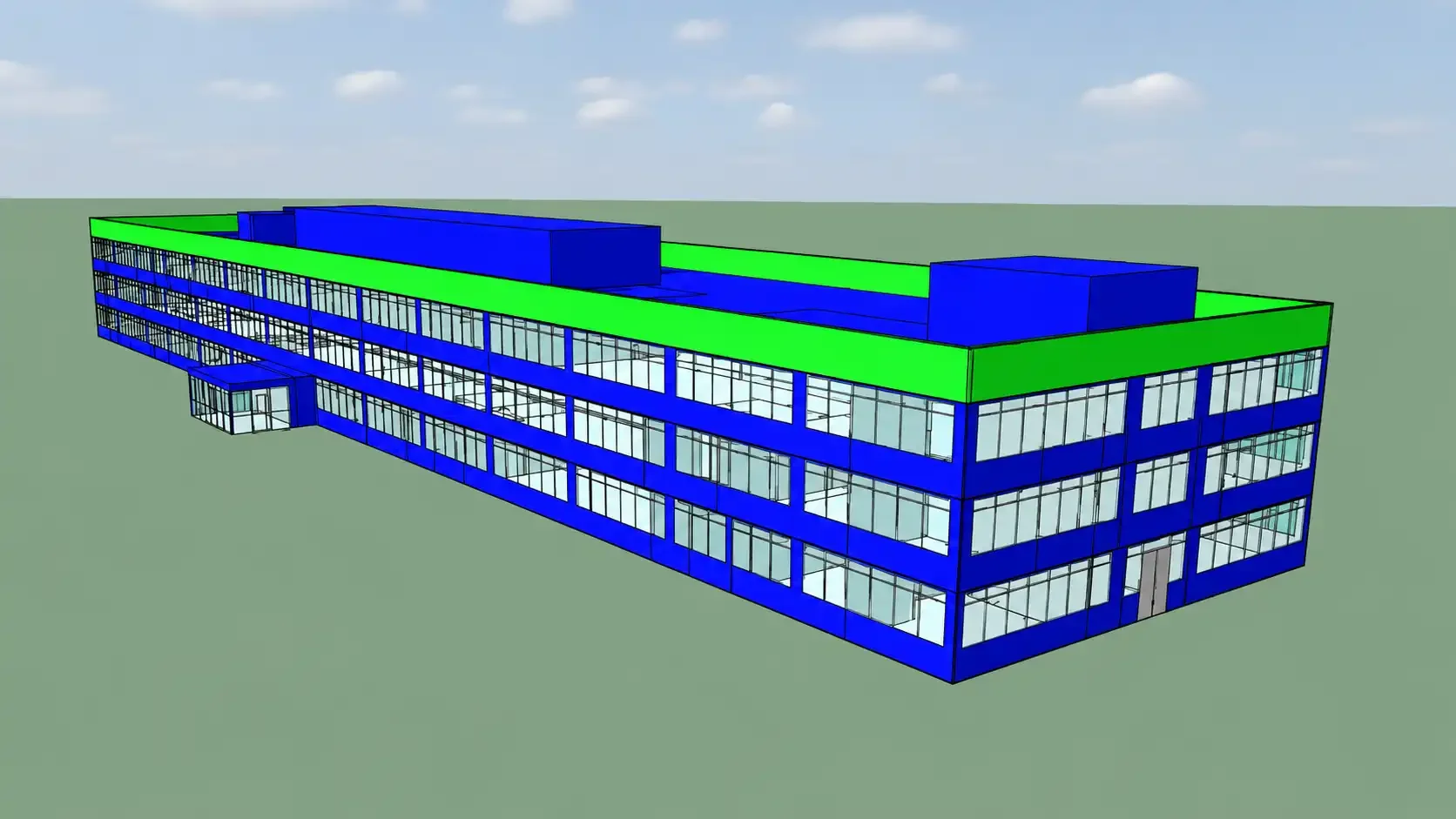
Airbus Building 45

2,039 m² Facility
Three-Storey Office Building
ROI / Carbon Saved / Output

M&E Services Design.

The Airbus Building 45 project involved the full mechanical and electrical services design for an existing office facility in Portsmouth, Hampshire, a key hub for advanced engineering and aerospace on the UK South Coast.

Salvis delivered a comprehensive Stage 3–4 M&E design package, including dynamic thermal modelling, HVAC system sizing, mechanical ventilation design, and electrical infrastructure to support new plant and services within a modern Portsmouth office refurbishment project.

The Challenge:

Accurately modelling heating and cooling loads across a 2,000 m² multi-zone building.
Designing HVAC systems for varying occupancy densities and usage profiles.
Coordinating ventilation, cooling, and heating systems across three floors.
Integrating new VRF systems into an existing building fabric.
Providing electrical infrastructure to support mechanical plant.

The Solution:

Salvis developed a fully coordinated M&E design solution built around real performance modelling.
Dynamic Thermal Modelling:
Undertook detailed IES-based building modelling to calculate heating and cooling demand.
Analysed conditions including external design temperatures down to −10°C (winter) and peak summer loads based on July/August profiles.
Calculated total building loads: heating demand ≈ 88 kW, cooling demand ≈ 143 kW.
VRF Air Conditioning System:
Designed a full Variable Refrigerant Flow (VRF) system across all floors.
Selected Mitsubishi Electric systems including multiple indoor unit types (ducted, cassette, wall-mounted) and centralised outdoor condensing units up to 100 kW capacity per system.
Delivered zone-by-zone control for occupant comfort and efficiency.
Mechanical Ventilation:
Designed mechanical supply and extract ventilation systems with heat recovery by implementing Mitsubishi Lossnay units (LGH-80RVX) to manage 2,039 m² across all floors.
Electrical Services Design:
Designed power supplies for all mechanical plant and equipment.
Completed cable sizing and containment design, and coordination of electrical loads with HVAC plant.
Ensured infrastructure supported VRF systems, ventilation units, and auxiliary systems.
Thermal Modelling Heating & Cooling Analysis
HVAC Systems VRF Air Conditioning
Ventilation Design Heat Recovery Systems
Electrical Design Plant Power Infrastructure

Frequently Asked Questions

  • Dynamic thermal modelling uses simulation software to predict how a building performs under different conditions. It calculates heating, cooling, and ventilation demands to ensure systems are correctly sized and energy efficient. 

  • VRF systems provide flexible, efficient heating and cooling with individual zone control. They are ideal for offices where occupancy and thermal loads vary throughout the day. 

  • Heat recovery systems reuse energy from exhaust air to pre-condition incoming fresh air. This improves efficiency, reduces energy consumption, and maintains good indoor air quality.