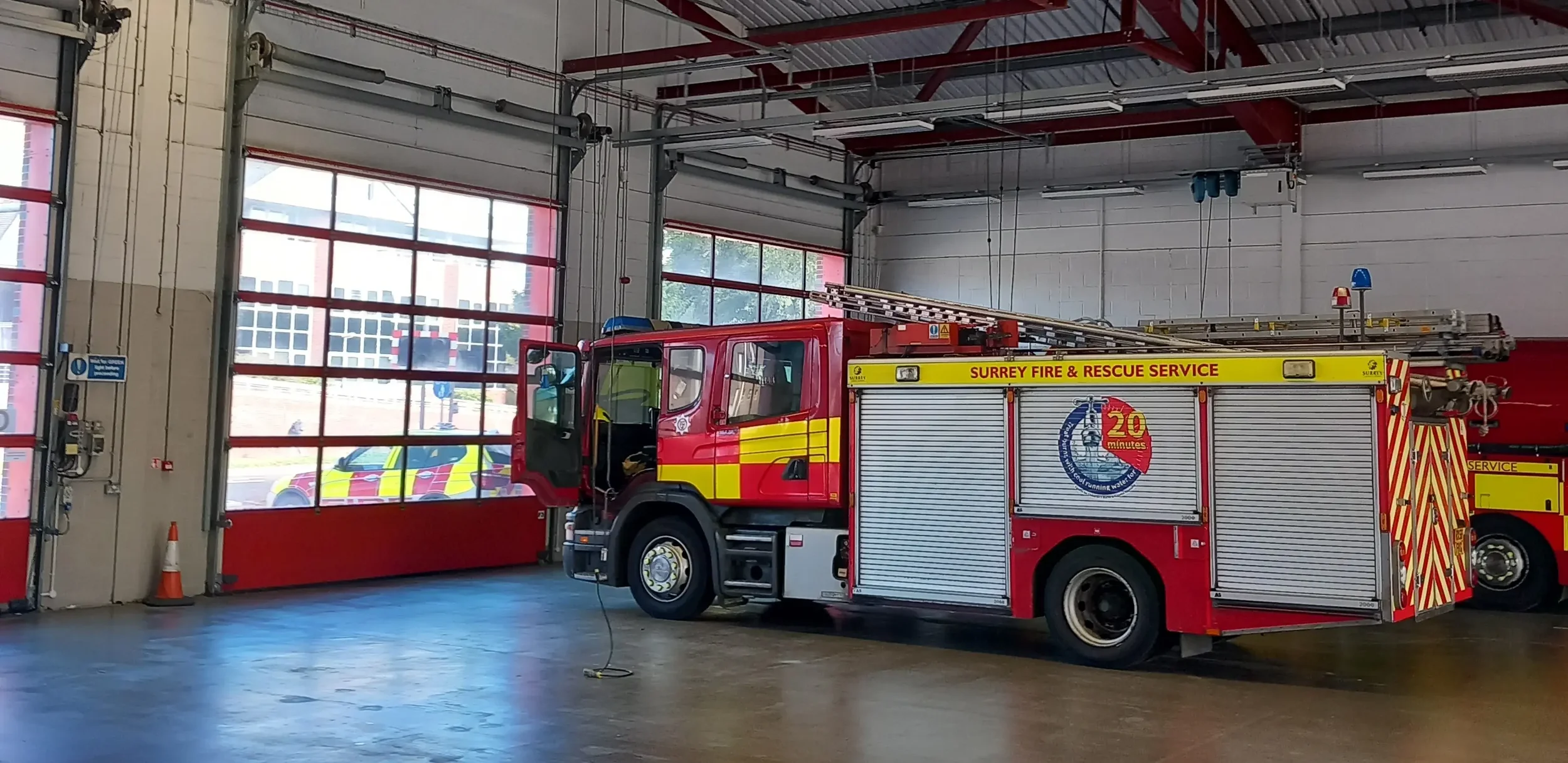
Guildford fire station
Emergency Services
- Client
- MKG Building Services
- End client
- Surrey County Council / Surrey Fire and Rescue Service
- Sector
- Emergency services / Public sector
- Location
- Guildford, Surrey
- Services
- RIBA Stage 4 M&E design, thermal modelling and heat pump design
- Value
- ~£750,000
Who worked on this project


Heat decarbonisation and M&E design
MKG Building Services appointed Salvis to deliver the RIBA Stage 4 mechanical and electrical design to decarbonise Guildford Fire Station, as part of a design and build contract. The station's end-of-life gas-fired heating and hot water plant was replaced with a system led by air source heat pumps, supported by solar thermal and solar PV.
Salvis surveyed the existing services and completed thermal modelling to confirm the heating demand. We then designed for a live emergency services building. Heating and hot water were essential services and stayed running throughout the works.
Scope of services
- Survey of existing M&E services.
- IES-VE thermal modelling and heat load assessment.
- Appliance bay heat loss and reheat calculations.
- Heat pump and low-temperature heating design.
- Domestic hot water and solar thermal design.
- Electrical load and LV distribution design.
- Supplies to new plant and PV connection.
- Drawings, calculations and equipment schedules.
- DNO liaison and supply upgrade support.
Key systems
- Three R290 (propane) air source heat pumps.
- Low-temperature heating distribution.
- 1,100-litre heating buffer vessel.
- 750-litre domestic hot water buffer vessel.
- Plate heat exchanger for hot water.
- Solar thermal collectors.
- Solar PV connection.
- Low-temperature heat emitters.
- Upgraded low-voltage distribution.

The project presented a number of technical challenges around the continued operation of the essential services and the resilience of system operation, which we were able to overcome with close working with our client to develop robust design principles.
Challenges
- Keeping services running during the works
- Rapid appliance bay reheat
- Domestic hot water generation
- Heat pump part load and short cycling
- Integration with existing heating circuits
- Working in an operational fire station
Lessons learned
01Model operational spaces on their own terms
Separate steady-state and reheat calculations showed the existing 48 kW of unit heaters could cover both the 23.85 kW heat loss and the rapid recovery the bay needs.
02Design hot water around heat pump temperatures
With a 65°C maximum flow temperature, a standard cylinder could not hold stored hot water at temperature. A plate heat exchanger and dedicated 750-litre buffer delivered suitable hot water and protected the heat pumps from short cycling.
03Keep maintainable kit out of operational areas
Six individual heat pump pipe runs back to the plantroom kept pumps, valves and separators out of the appliance bay, away from potential damage and day-to-day operations.