
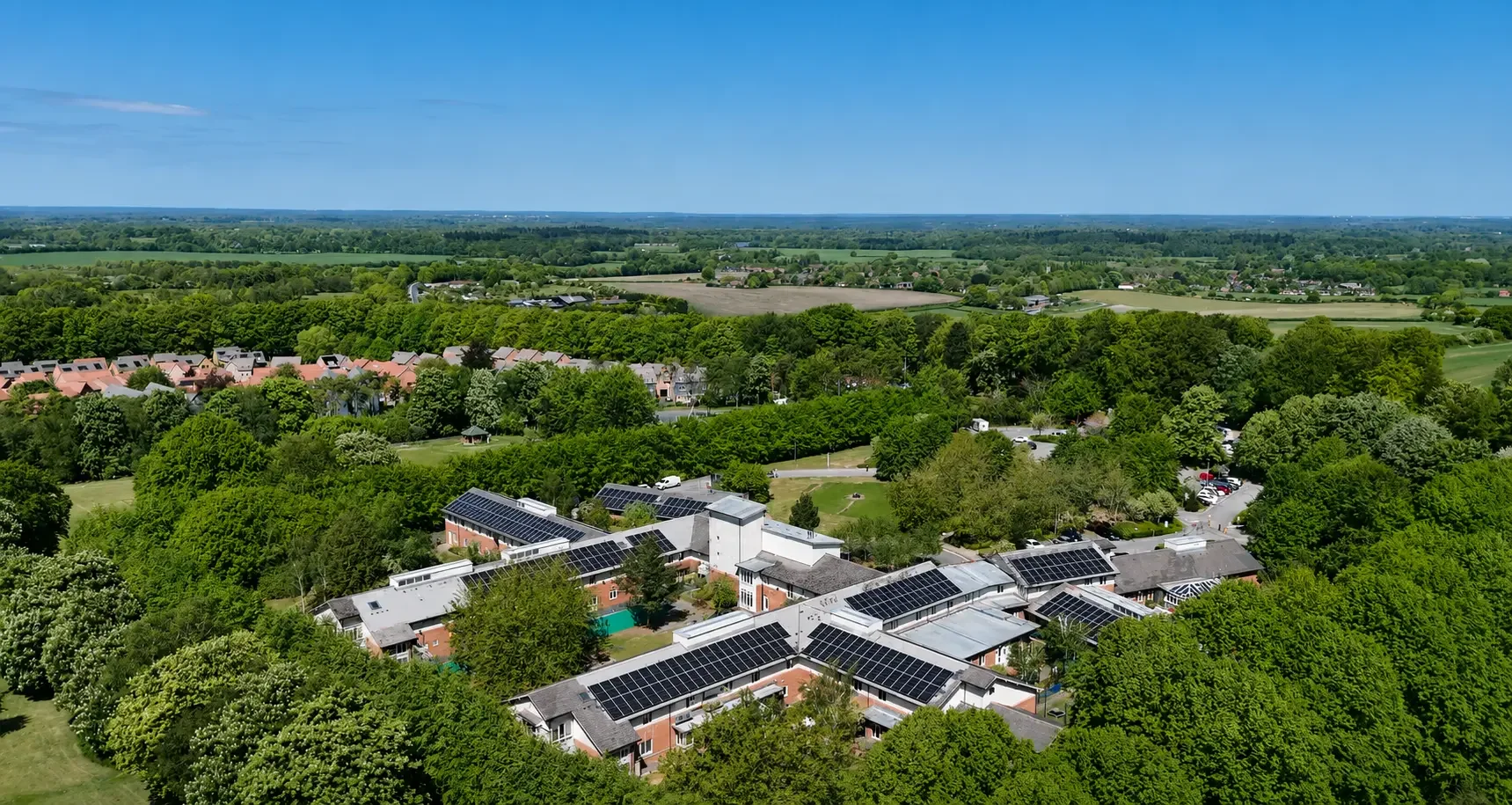

From 24 March 2027, the updated Part L building regulations will come into force across England, raising the bar for energy efficiency, low-carbon heating and on-site renewable generation. If you're involved in planning, designing or managing buildings, the time to act is now.
WHAT IS THE FUTURE HOMES STANDARD?
The Future Homes and Buildings Standard is the government's overhaul of Part L of the Building Regulations, which governs energy performance in England. The goal is simple: new buildings should be built correctly from the outset, with low-carbon heating, high energy efficiency and renewable electricity generation, so they don't need expensive retrofit to reach net zero later.
The standard applies to new homes and non-domestic buildings alike, covering everything from housing developments and schools to leisure centres, offices, depots and heat network projects.

Rooftop PV is no longer optional, as the new standard requires on-site renewable generation for new homes.
THE KEY DATES
Three deadlines define the transition. Crucially, they apply building by building, not site wide. A large development could have some buildings under old rules and others under the new standard depending on when each building's application was submitted.
WHAT IS ACTUALLY CHANGING?
1. LOW-CARBON HEAT BECOMES THE DEFAULT
The standard doesn't simply ban gas, but it makes fossil-fuel heating strategies much harder to justify. For most new buildings, the direction of travel is clear: heat pumps, low-temperature heat networks and communal heating systems will become the expected approach.
For retrofit and planned maintenance, the message is equally important. Even where full decarbonisation isn't happening yet, maintenance programmes should be preparing buildings for lower-temperature heating rather than replacing boilers in isolation.
"Replacing a boiler in isolation is increasingly the wrong move, as planned maintenance should be preparing buildings for lower-temperature heating."
2. SOLAR PV MUST BE CONSIDERED FROM DAY ONE
The updated standard introduces a requirement for on-site renewable electricity generation for new homes and buildings containing dwellings. For non-domestic buildings, the notional building now includes PV equivalent to 40% of the building's footprint area. PV can no longer be a late-stage add-on.
Roof form, orientation, structural loading, plant layout, rooflights, fire access zones and grid export capacity all need to be considered from the earliest stages of design, rather than after planning has been granted.
3. COMPLIANCE RISK MOVES UPSTREAM
Under the old approach, energy compliance was often resolved at detailed design stage through SAP or SBEM calculations. Under the new standard, projects designed around old assumptions, such as gas-led heat, minimal PV and inadequate electrical infrastructure, may need significant redesign if the issues aren't caught early.
That means stronger coordination between architecture, M&E engineering, energy modelling, planning, building control, cost consultancy and asset management, and it needs to happen at feasibility stage, not at RIBA Stage 4.
WHAT SHOULD YOU DO NOW?
The most important first step is a pipeline review, identifying every project in planning, design, procurement or construction and assessing which buildings are exposed to the 2027 transition. For each, five questions are worth answering:
The organisations that act early will avoid late redesign, procurement delays and unnecessary cost increases. Those that wait may find themselves revisiting schemes after planning consent, during procurement, or close to construction start, exactly when changes are most disruptive.
HOW SALVIS CAN HELP
We work with public and private sector clients across the full range of challenges the Future Homes and Buildings Standard creates. Our readiness review covers:
READY TO REVIEW YOUR PROJECT PIPELINE?
Part L 2026 is not just a compliance update, it is a design, procurement and asset strategy issue. Get in touch with the Salvis team to discuss a readiness review before the deadlines become urgent.